How to check the authenticity of a football jersey? The complete guide

Buying a football shirt on Vinted, eBay, or any peer-to-peer marketplace has become a minefield. Today's counterfeits no longer look like the crude fakes of ten years ago — logos are better centered, colors are more accurate, fabrics are more convincing. To the naked eye, the difference is often invisible.
⚡ Quick answer
To verify the authenticity of a football shirt, three complementary methods are essential: (1) locate the serial number on the inner tag and check it on Google Images, (2) physically inspect the 5 key points (fabric, stitching, embroidered logos, crest, nameset), (3) cross-check with a secondary authentication tag where one exists (Nike, Adidas post-2010). This expert method catches 99% of counterfeits, even the most recent ones.
I authenticate shirts year-round in my workshop. Every week, disappointed buyers contact me with a shirt they believed was authentic, bought for €80 on a marketplace, that turns out to be a Chinese counterfeit worth €15. This guide contains the exact method I use myself, whatever the brand, whatever the era of the shirt. By the end of this article, you'll be able to tell a real shirt from a fake in under 3 minutes, even with no prior expertise — and recognize an authentic shirt without hesitation.
The Football Shirt Counterfeit Market: A Fast-Growing Plague
According to the latest official EUIPO report (European Union Intellectual Property Office), the clothing counterfeit market represents a shortfall of nearly 12 billion euros a year in Europe, or 5.2% of the sector's total sales, and causes the loss of 160,000 jobs annually in the legitimate industry. And football shirts are on the front line. Three reasons explain this explosion: Chinese factories that have massively improved their quality in recent years, marketplace platforms with no strict controls, and official retail prices (sometimes €150 for a brand-new shirt) that push consumers toward questionable alternatives — often without them knowing they're buying fakes.

A fake (left) and an authentic shirt (right) can look identical in a quick photo. It's in the details that everything is decided.
Buying a counterfeit shirt isn't just a bad deal — it's a problem on four levels. You receive a poor-quality product that degrades after a few washes. You lose all resale value — a fake is worth nothing on the secondary market. You indirectly support counterfeiting operations, often linked to illegal labor practices. And in France, reselling counterfeit goods carries a penalty of up to 4 years in prison and a €400,000 fine under Article L716-9 of the Intellectual Property Code (Légifrance), reinforced by the Ordinance of 13 November 2019.
The good news: counterfeiters keep improving, but so do authentication and verification methods. Here's exactly how I proceed for every item that enters my workshop, to guarantee a lifetime authenticity certificate on every shirt sold.
The Serial Number Method: 3 Steps to Verify in 2 Minutes
Every authentic football shirt produced since 2002 carries a unique serial number, printed on the inner tag sewn into the collar or the hem of the shirt. This code is the shirt's fingerprint: it lets you recognize an authentic shirt and detect a fake shirt within seconds. Here's the complete three-step method.
Step 1 — Locate the Serial Number on the Inner Tag
Turn the shirt inside out and look for the tag sewn on the inside. Depending on the brand, it's located in a different spot. On a Nike shirt, the tag is sewn inside the shirt (under the wash-care labels). On a post-2010 Adidas shirt, it's in the collar. On pre-2010 Adidas shirts (2002-2009), it's sewn at the bottom of the shirt on the inside, on the right side. On Puma and Umbro, it varies by year.
The serial number comes as an alphanumeric code. On Nike, the format is DX9822-568 or similar. On modern Adidas, the format is AZ8059 or equivalent. On pre-2010 Adidas, a 6-digit number such as 156653. On Puma, series such as 757035-01.

Authentic Nike tag: product code DX9822-568 in clear, legible text, neatly sewn in.

Authentic Adidas tag: code AZ8059 with manufacturing date 06/17 consistent with the 2017-2018 season.
Step 2 — Type the Code into Google Images
This is the decisive step. Open Google, type the exact code into the search bar, then click the "Images" tab. Three possible scenarios:
Scenario A — The images show exactly your shirt. The code matches, the reference is authentic. Move on to step 3 for the final physical check. 95% of shirts that pass this test are authentic.

Scenario A — Code DX9822-568 only returns the purple Liverpool Third 2023-2024 shirt on Google Images. Authentication confirmed.
Scenario B — Few or no images show up. Paradoxically, this is often a good sign. It indicates a rare or vintage piece with little presence on current marketplaces. Shirts from the 2000s especially tend to give this result. In that case, check the physical points from step 3.
Scenario C — The images show a chaotic mix of completely different shirts. An absolute red flag. Counterfeiters often reuse the same recycled codes across dozens of models. If your "2019 PSG shirt" brings up shirts from Brazil, a Romanian club, and a rugby team all under the same code, it's a fake with 99.9% certainty.
Step 3 — Cross-Checking the Secondary Tag
On Nike shirts, there is a second black tag sewn on the inside at hip height, bearing the word "AUTHENTIC" and a multi-digit code. This code is completely unique in the world: no other shirt shares it. Type it into Google: if results come up, it's a fake. If it returns nothing, you have an authentic Nike Player version. For the full breakdown of this Nike method, check out my dedicated guide to fake Nike shirts.
On a post-2010 Adidas shirt, check that the manufacturing date printed on the tag (format MM/YY, e.g. 06/17 = June 2017) is consistent with the shirt's season. A 2017-2018 shirt should carry a date between 06/17 and 05/18. A date mismatch is a red flag. Full method in my Adidas anti-counterfeit guide.
How to Tell If a Football Shirt Is Real in 30 Seconds?
To tell if a football shirt is real in 30 seconds, run these three immediate visual checks: run your finger over the embroidered logos (dense texture = real, flat or fraying = fake), turn the shirt inside out and look for the inner tag with a product code (present = good sign, missing or "scribbled" in pen = fake), check how even the stitching is at the sleeves and collar (flawless = real, irregular = fake). This express method doesn't replace the full serial-number verification, but it eliminates 70% of crude counterfeits in seconds.
Four other quick visual indicators round out this flash check:
The price. A brand-new Ronaldo Portugal shirt for €35 on Vinted is very often a bad sign. Prices that seem too good to be true almost always are. An authentic vintage shirt from the 90s-2000s rarely starts below €60.
The seller's photos. If the photos all look identical, shot on a white background with a catalog-style finish, it's probably Chinese dropshipping. A genuine private seller posts personal photos, from several angles, clearly showing the inner tag.
The nameset. On an authentic shirt, the nameset (player's number and name) uses the exact typography of that season. A spelling mistake, a slightly different font, a misaligned digit — all signal a fake. Official typography databases are available online to check against.
The competition patches (Champions League, World Cup, Ligue 1). On an authentic shirt, they are embroidered and neatly stitched on. On a fake, they're often unevenly heat-pressed, sometimes off-center, or they peel off after the first few washes.
Pure Service · Certificate of Authenticity
Get an Official Certificate of Authenticity
The full method from this article, applied by me to your shirt — no matter where you bought it. You receive a numbered, verifiable certificate: an official document that reassures the buyer and raises the resale value.
⚡ Limited authentication slots each week to guarantee the 24-hour verdict — first come, first served.

The 5 Physical Points to Inspect on the Shirt
Product codes are your first safety net. Your eyes and hands are the second. Whatever the brand, five physical elements tell the story of a shirt. I inspect them systematically at the Pure workshop before any listing goes live, as part of my full football shirt verification process.
The Fabric and Its Feel
An authentic shirt has a fabric that's characteristic of its brand and era. Nike uses Dri-FIT or Vaporknit depending on the version, with an immediate technical feel, slightly grainy. Adidas uses Climacool or HEAT.RDY, with a smoother, softer fabric. On a 90s-2000s vintage shirt, the polyester is thicker, matte, and noticeably heavier than a modern fabric. A simple test: mentally weigh the shirt in your hand. A counterfeit is often either too light (cheap polyester) or too heavy (generic thick fabric).
The Stitching
Turn the shirt inside out and inspect the inner stitching, particularly at the sleeves, collar, and sides. On an original, the stitches are even, tight, with no loose threads. The finishes at the ends are clean. On a fake, the stitching often has spaced-out stitches, loose threads, or frayed ends. This is one of the hardest signs to replicate in a counterfeit.
The Brand Logos (Nike Swoosh, Adidas Three Stripes)
Run your fingernail over the brand logo. On a recent authentic shirt, it's embroidered with dense, even relief, or heat-pressed with a precise texture. On a fake, the logo is often flat, directly printed, or has edges that fray. On vintage Adidas shirts, the three stripes must be strictly parallel and rigorously identical in width.

On the left, the fake embroidery — flat, sparser threads. On the right, the original — pronounced relief, high stitch density, perfectly defined feather details.
The Club Crest
Same principle. On an original, the crest is either embroidered with thick thread and pronounced relief, or heat-pressed with a precise texture that resists scratching. On a fake, it peels off after two or three washes, or cracks at the edges. Crests with fine details (Real Madrid, Juventus, Liverpool) are the hardest to counterfeit properly.
Player Namesets
The nameset (name + number) uses an official typography that's different for every season of every club. A typo, a slightly off font, a poorly proportioned number — all signal a fake. Official fonts can be checked against databases such as Football Shirt Culture. On vintage shirts, the nameset is applied either as heat-pressed flock (velvet) or as stitched lettering. The quality of the application is a reliable indicator.
The 6 Brands and Their Authentication Specifics
Each manufacturer has its own authentication method. Here are the key points by brand, with links to my dedicated guides where they exist.
Nike
The most counterfeited brand in the world. Look for the product code on the collar tag (format XX1234-567), and check it on Google Images. For Player (match) versions, the black "AUTHENTIC" tag with a 9-digit code is decisive. Dri-FIT or Vaporknit fabric depending on the version. Full Nike method.
Adidas
The second most copied brand. Three eras to distinguish: pre-2002 (visual authentication only, no code), 2002-2010 (tag at the bottom of the shirt with a 6-digit code such as 156653), post-2010 (tag in the collar with code AZ8059 and a consistent manufacturing date). Full Adidas method.
Puma
Historically the kit supplier for Italy, Uruguay, and OM. Puma product codes follow the format XXXXXX-XX (e.g. 757035-01). Verification is identical to Nike: Google Images, date consistency. Puma fabric has a distinctive grainy signature, drier to the touch than Nike.
Umbro and Kappa
The two most sought-after vintage brands from the 90s-2000s. Kappa supplied Italy, Juventus, and AS Roma during that era — the Kappa Juventus Zidane shirts are among the most counterfeited pieces on the collector market. Umbro supplied England, Manchester United, and OM during its golden Nike Air years. For these brands, authentication is almost entirely visual (no product code pre-2005). Focus on the quality of the three stripes, the clover logo, the weave, and compare against period photos of authenticated shirts.
Lotto
An iconic Italian manufacturer from the 90s-2000s (Juventus 94-95, Milan 92-93). Rare shirts today. Authentication is almost entirely visual, comparison against certified references is essential.
The Most Copied Shirts — Extra Caution Required
Certain shirts account for 80% of counterfeits on the French market. If you come across one of these models at an unusually low price on a marketplace, apply the full 3-step method before buying. Here's the blacklist:
— France 1998 Zidane N°10 nameset: the most counterfeited shirt in the history of French football. 95% of "France 98 Zidane" shirts under €80 are fakes or modern reissues. Browse the authenticated France national team shirts to compare against certified pieces.
— PSG × Jordan: every season since 2018. The most copied collaboration of the decade — Chinese fakes are now extremely convincing visually. See the authentic PSG shirts.
— Portugal Ronaldo: all editions 2004-2022. The Euro 2004 and 2016 versions are the most targeted by counterfeiters. Browse the vintage Portugal collection.
— FC Barcelona Messi-Neymar-Suárez era (2014-2017): the electric Third shirts (fluo yellow, pink, turquoise) are massively faked. See the authenticated FC Barcelona shirts.
— Zidane Real Madrid Centenary 2001-2002: the grail piece, the most reproduced on the Real Madrid market. See my full breakdown in my guide to Zidane shirt values.
— Argentina 1986 Maradona and 2022 Messi: the top and bottom bookends of the Albiceleste era, both massively counterfeited.
The 4 Authenticated Pieces Currently in Stock
Each of these pieces has passed my full workshop verification. They're among the most copied on the market — but these examples are 100% authentic and covered by my lifetime authenticity guarantee.
Authenticated Gems — Lifetime Guarantee
2006 World Cup Final
France 2006 Home
Zidane N°10
Size S · Condition 9.5/10 · Adidas. Only 1 left.
€124.99
View the shirtVerdy Edition
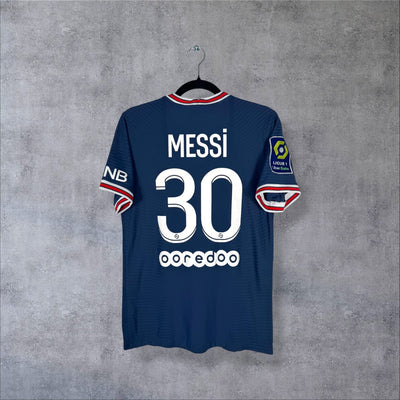
PSG 2022-2023 Away
Messi N°30
Size S · Perfect condition 10/10 · Nike Jordan. One of a kind.
€149.99
View the shirtEuro 2008 Era
Portugal 2008-2010 Away
Ronaldo N°7
Size L · Condition 9/10 · Nike. One of a kind.
€114.99
View the shirtTiki-Taka Era
FC Barcelona 2012-2013
Messi N°10
Size XXL · Perfect condition 10/10 · Nike. One of a kind.
€129.99
View the shirtThe 4 Questions I Get Asked Most Often
Authenticating shirts all year round, four questions come up time and again. Here are my direct answers.
← Scroll →
01
"Is a replica shirt a fake?"
No, a replica (or "stadium") shirt is 100% authentic. It's the version sold to the general public in stores, with a regular fit, embroidered logos, and standard fabric. The "authentic" (or "player", "pro") version is the one worn by players on the pitch: slim fit, heat-pressed logos, high-performance technical fabric. Both are official — only the intended use changes.
02
"My shirt has no product code at all — is it a fake?"
Not necessarily. Shirts made before 2002 had no traceable product code (Nike started in 2002, so did Adidas). An authentic France 1998 or Juventus 1996 shirt may very well have no code at all. In that case, authentication rests entirely on the visual points: period-correct fabric, stitching, logos, and comparison with reference photos.
03
"My Google code search gives inconsistent results — is that bad?"
It's the most reliable red flag there is. If your product code brings up a chaotic mix of completely different shirts on Google Images (different clubs, different sports, different sizes), it's a counterfeit 99% of the time. Counterfeiters recycle the same codes across dozens of models to create an illusion. Always cross-check with the physical points before concluding.
04
"Is there an official certificate of authenticity for a shirt?"
There is no official brand certification (Nike, Adidas, and Puma don't issue certificates). The only valid certificates come from specialized independent authenticators. At Pure Football Shirts, every shirt ships with a detailed product page listing its authenticity code, its condition rated out of 10, and a lifetime authenticity guarantee: every piece is hand-inspected in the workshop — tags, stitching, logos, nameset — backed by a numbered certificate. And if you already own a shirt, I can authenticate it 100% online: photos → expert verdict within 24 hours + official numbered certificate included — €9.99 all included.
The Pure Workshop: Why Going Through an Authenticator Changes Everything
The method I've just detailed works. But it takes time, rigor, access to reference databases, and above all experience to correctly interpret what you find. This is precisely why Pure Football Shirts exists: every shirt that enters stock goes through my authentication workshop before being listed for sale.
I check the product code against official databases. I inspect the secondary tag where one exists. I check the stitching, fabric, and logos by hand. I compare against my archive of authenticated reference photos. And I document everything: every product page shows the shirt's authenticity code, any flaws via my condition grading scale out of 10, and its season history.
My Lifetime Authenticity Guarantee is simple: every shirt bought on Pure Football Shirts is hand-inspected in the workshop — tags, stitching, logos, nameset — before it's listed for sale, and its authenticity is guaranteed for life, backed by a numbered certificate. No other shop in France offers this level of rigor on vintage shirts.
And you don't need to have bought from me to take advantage of this: if you already own a shirt, I can authenticate it 100% online: photos → expert verdict within 24 hours + official numbered certificate included — €9.99 all included — the document that reassures the buyer and boosts your piece's resale value.
For those who want the fun of a surprise without the authentication legwork, the Pure Mystery Box at €44 delivers a pre-authenticated vintage shirt, hand-picked to match your size. The market value always exceeds the price of the box. It's the simplest way to start or grow a collection with complete peace of mind.
Go Further
- → Get your shirt authenticated online — expert verdict within 24 hours, certificate included — €9.99 all included
- → 10 authentications + 10 certificates pack — €29.99
- → How to recognize a fake Nike shirt (detailed guide)
- → How to recognize a fake Adidas shirt (decade-by-decade method)
- → Authentic vs Replica: what's the real difference?
- → Zidane shirts: value of rare pieces
- → How to estimate the value of a rare shirt
- → Vintage shirt sizing guide
- → The Pure Workshop — my full process
- → The Pure Mystery Box (€44)
Still not sure?
Doubts about your shirt's authenticity?
Before buying or reselling, have your piece checked by the Pure workshop: verdict within 24 hours and an official, numbered certificate to reassure buyers and raise the resale value.
⚡ Limited authentication slots each week to guarantee the 24-hour verdict — first come, first served.
Understand shirt condition grading →
Get our fake alerts & authentication guides